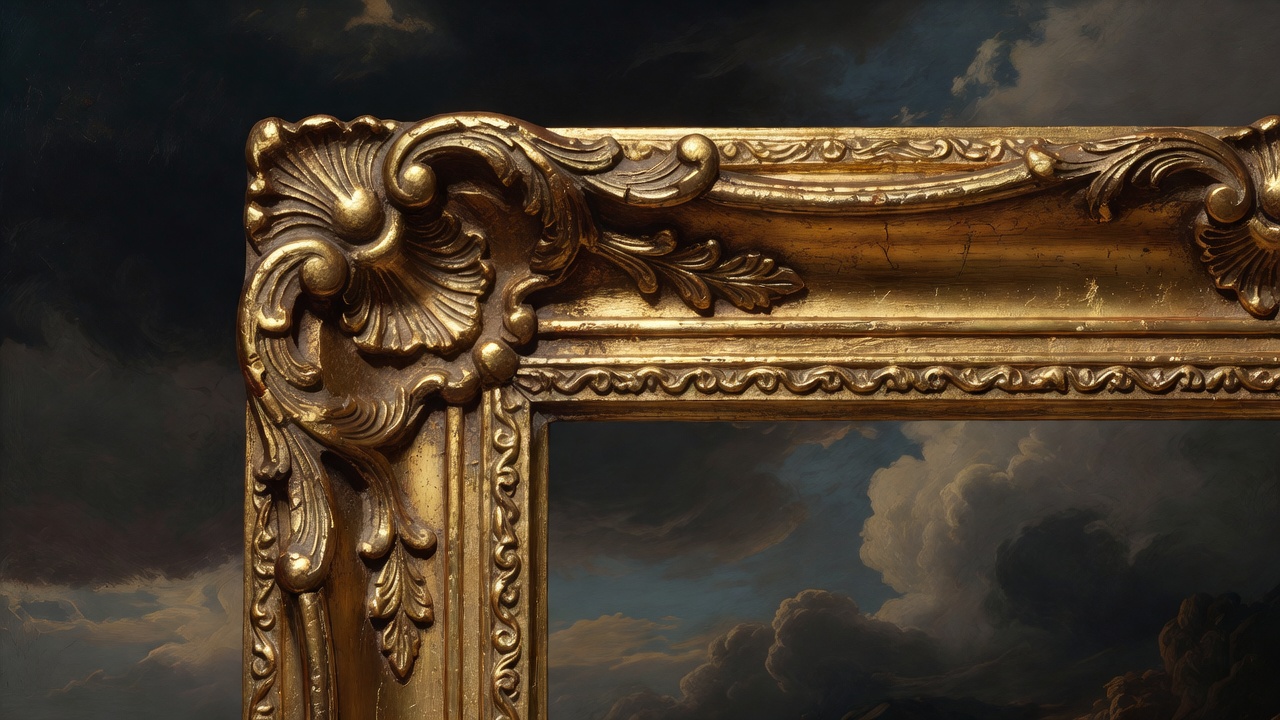
Landscape was once considered a humble genre, ranked below history painting, portraiture and scenes of everyday life by the academies of Europe. The painters in this room changed that hierarchy. They proved that a field, a river or a sky could carry as much thought and emotion as any biblical drama, and they did it on stretched canvas, the support that made large, portable, exhibition-ready landscapes possible.
Walk the timeline slowly. Each painter solved a problem the next one inherited, and each solution is still visible in landscapes being painted and sold today.
Claude Lorrain and the Ideal Landscape
Working in Rome, Claude built calm, theatrical compositions: dark framing trees, a luminous centre, and the sun itself placed low in the sky. His Seaport with the Embarkation of the Queen of Sheba (1648) in the National Gallery, London, taught generations that light could be the true subject of a painting.
John Constable and the Truth of the Weather
Constable painted the Suffolk countryside he knew as a boy. His full-size oil sketches and cloud studies of the 1820s, made on Hampstead Heath, recorded the time, wind and weather on the back. The Hay Wain (1821) remains one of the most visited canvases in London, admired as much for its flecks of white "Constable's snow" as for its cart in the river.
Caspar David Friedrich and the Inner Landscape
In Germany, Friedrich turned landscape inward. Wanderer above the Sea of Fog, in the Hamburger Kunsthalle, places a figure with his back to us, inviting the viewer to stand where he stands. Fog, mountain and silence become metaphors for spiritual experience.
J. M. W. Turner and the Dissolving World
Turner pushed light and atmosphere until solid forms nearly vanished. The Fighting Temeraire (1839) sets a ghostly warship against a blazing sunset, while Rain, Steam and Speed (1844) lets weather and industry blur together. His bequest at Tate Britain holds hundreds of oils and thousands of works on paper.
Corot and the Barbizon School
Camille Corot, Théodore Rousseau and their circle worked in the Forest of Fontainebleau, painting directly from nature. Corot's silvery late canvases show how a restrained palette and soft edges can feel more truthful than heroic drama.
The Hudson River School
Thomas Cole's The Oxbow (1836) at the Metropolitan Museum of Art divides wilderness from cultivated farmland under a passing storm. His pupil Frederic Edwin Church painted Heart of the Andes (1859), exhibited to paying crowds who viewed it through opera glasses. Albert Bierstadt carried the grandeur west with canvases such as Among the Sierra Nevada, California (1868), now at the Smithsonian American Art Museum.
Monet and the Impressionist Moment
Claude Monet's Impression, Sunrise (1872), at the Musée Marmottan Monet in Paris, gave a movement its name. The Impressionists painted the fleeting effect rather than the permanent form, helped by portable tube paints and lighter easels.
Cézanne, Van Gogh and the Group of Seven
Paul Cézanne returned again and again to Mont Sainte-Victoire, rebuilding landscape from planes of colour. Vincent van Gogh charged fields and cypresses with rhythm. In Canada, Tom Thomson's The Jack Pine (1916–17) and the Group of Seven claimed the northern wilderness as a national subject.
What the Masters Still Teach
For painters, the lesson of this room is that every great landscape is built on a decision. Claude decided the light source would sit inside the picture. Constable decided weather was worth recording honestly. Friedrich decided the viewer should feel present. Turner decided form could yield to atmosphere. When you set up your easel, name your own decision before you mix a colour.
For collectors, the masters offer a vocabulary. When a contemporary canvas reminds you of Corot's silvery greys or Church's theatrical sunsets, you are recognising a lineage. Understanding that lineage helps you judge whether a painter has absorbed a tradition or simply imitated its surface.
"The sky is the source of light in Nature, and governs everything." — John Constable, in a letter to John Fisher, 1821
Visiting the Originals
Reproductions flatten everything that makes these canvases remarkable: the raised ridges of Constable's palette knife, the thin scumbles of Turner's skies, the glossy darks of Church's foregrounds. If you can, stand in front of the originals. Visit early, step back to the distance at which the picture resolves, then step close enough to see the brushwork break apart. That double reading, illusion and paint at once, is the quiet pleasure of landscape on canvas.
Continue to Room II to see how these painters actually worked, outdoors and in the studio.